Dog feeding schedule: how often and when
An adult dog eats twice a day — morning and evening, roughly 10 to 12 hours apart. Puppies eat more often: four times a day up to four months, three times between four and six months, and from six months on they move to twice a day.
- Consistency matters more than the exact hour. The same time every day settles digestion and cuts down on begging.
- Portion size comes from your dog’s weight and the calorie density of the food — start with the chart on the packaging and adjust to body condition.
- Treats count towards the daily ration. Past roughly 10% of it, they start displacing complete food.
How many meals a day, by age
Frequency changes as a dog grows. The meal counts below are standard practice; the exact portion depends on breed, activity and the health of your particular dog.
| Age | Meals per day | What to keep in mind |
|---|---|---|
| 8 weeks – 4 months | 4 | A small stomach and fast growth. Four small meals keep blood sugar steady — in toy breeds a missed meal can bring on hypoglycaemia. |
| 4 – 6 months | 3 | Growth slows and the puppy copes with longer gaps. The midday meal goes, and its food is spread across the remaining two. |
| 6 – 12 months | 2 | Most dogs settle into morning and evening. Large breeds grow for longer — their switch to adult food is often held back to 12–18 months. |
| Adults (1 – 7 years) | 2 | Morning and evening, in roughly equal portions. A single daily meal loads the stomach all at once and raises bloat risk in deep-chested breeds. |
| Over 7 years | 2 – 3 smaller | Smaller, more frequent portions digest more easily. At this age changes in weight and appetite are an early signal and worth logging. |
How much food per day: daily ration by weight
A universal “grams per kilo” table does not exist, because foods differ in calorie density. It takes two steps: how many calories your dog needs a day, then what that is in grams of your particular food.
Daily calories come from 70 × (weight in kg to the power of 0.75) × a lifestyle factor. For a neutered adult dog that factor is about 1.6; intact, 1.8; a puppy under four months, 3.0, and up to a year, 2.0; for weight loss, 1.0.
| Weight | Calories per day | Example amount |
|---|---|---|
| 2 kg | ≈ 190 kcal | ≈ 50 g |
| 3 kg | ≈ 255 kcal | ≈ 65 g |
| 5 kg | ≈ 375 kcal | ≈ 100 g |
| 10 kg | ≈ 630 kcal | ≈ 165 g |
| 20 kg | ≈ 1060 kcal | ≈ 280 g |
| 30 kg | ≈ 1435 kcal | ≈ 380 g |
| 40 kg | ≈ 1780 kcal | ≈ 470 g |
The third column assumes a neutered adult dog and dry food at 380 kcal per 100 g — a common figure, but check your own bag. For any other food: divide the daily calories by the calories in 100 g and multiply by 100. Treat the result as a starting point — after two weeks judge by body condition: ribs should be easy to feel but not visible.
Puppies: weaning and how much
A puppy needs two to three times more calories than an adult dog of the same weight. First it moves from milk to solid food — weaning — and from then on its ration is worked out from its current weight.
- 3 – 4 weeksFirst tastes of solid food: puppy food soaked in warm water to a thin gruel, 1 – 2 times a day. The puppy keeps nursing.
- 5 – 6 weeksThe gruel thickens and meals go up to 3 – 4 a day. By around day 40 the puppy eats more food than it nurses.
- 7 – 8 weeksFully weaned: puppy food, lightly soaked or dry, 4 times a day. In small breeds weaning can run to 10 weeks.
- neverCow’s milk. Most puppies do not tolerate it and get diarrhoea. Without the mother, use a canine milk replacer.
| Weight now | Up to 4 months | 4 to 12 months |
|---|---|---|
| 2 kg | ≈ 355 kcal · ≈ 95 g | ≈ 235 kcal · ≈ 60 g |
| 5 kg | ≈ 700 kcal · ≈ 185 g | ≈ 470 kcal · ≈ 125 g |
| 10 kg | ≈ 1180 kcal · ≈ 310 g | ≈ 785 kcal · ≈ 205 g |
| 20 kg | ≈ 1985 kcal · ≈ 525 g | ≈ 1325 kcal · ≈ 350 g |
Worked out with a factor of 3.0 up to 4 months and 2.0 up to a year, for dry puppy food at 380 kcal per 100 g — usually between 350 and 420, so check the bag. Work from the current weight and recalculate every month while it grows. Up to 4 months the ration is split into 4 meals, up to 6 into 3. Large breeds grow until 18 months and overfeeding strains their joints, so slightly under is better than over.
A sample day on two meals
An example for an adult dog with the daily ration split in half. Treat the hours as a guide — shift them to your own routine, then keep them.
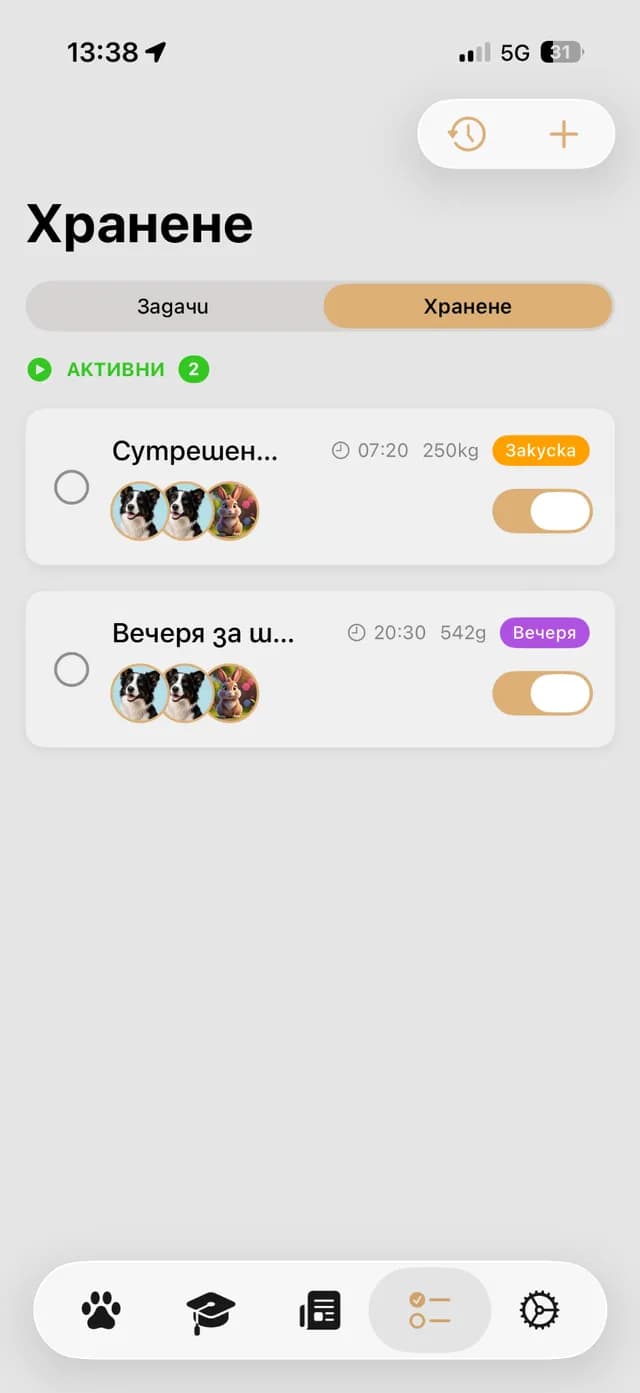
Build the schedule in the app
A sheet on the fridge works until someone walks past it. In PetsClub the schedule sits on every phone in the house and the reminder arrives at the right hour — so nobody feeds twice and nobody forgets.
- Add your dog and choose how many meals a day it needs
- Set the time and the amount for each one
- Turn on reminders and share the profile with the rest of the household
Common questions about feeding a dog
What should a 6-week-old puppy eat?
At around 6 weeks — day 40 — a puppy is in the middle of weaning. It eats puppy food soaked in warm water to a thick gruel, 3 – 4 times a day, and still nurses. No cow’s milk: most puppies do not tolerate it. It is fully weaned by weeks 7 – 8.
How much food should a puppy eat?
It depends on current weight and age. Up to 4 months a puppy needs about three times its resting energy, after that about twice. A 5 kg puppy at 3 months eats about 700 calories a day, roughly 185 g of dry food, split into 4 meals. Recalculate every month while it grows.
How many times a day should an adult dog eat?
Twice — morning and evening, about 10–12 hours apart. That splits the daily ration so your dog is never hungry for too long and the stomach never takes one oversized portion.
What are the best hours to feed a dog?
There are no universally right hours — what matters is that they are the same every day. Around 7am and around 6–7pm is the common choice, because it fits most households and leaves time for a walk before bed.
Can a dog eat just once a day?
Some adult dogs manage, but it is not the better option. One large meal loads the stomach at once and, in deep-chested breeds such as German Shepherds, Great Danes or Setters, raises the risk of gastric torsion. Talk it through with a vet before switching.
When does a puppy go from three meals to two?
Usually around six months. Make it gradual: over a week or two, shrink the midday portion and move it into breakfast and dinner. For large breeds a vet may advise a later switch.
Can I leave food out all day?
Free feeding is not recommended for dogs. It is hard to tell how much was eaten, portions drift upwards and weight gain follows. It also hides a loss of appetite — one of the earliest signals that something is wrong.
How long after eating can a dog exercise?
Avoid running, jumping and rough play for at least an hour after a meal. In large deep-chested breeds this is among the standard recommendations for lowering the risk of gastric torsion. A calm walk right after eating is fine.
Set the reminders once
The hard part of any schedule is keeping it every day. In PetsClub you enter the times and portions once, and the phone does the remembering — for you and for anyone else at home who feeds the dog.
- Repeating reminders for every meal, with a push notification on time
- A separate schedule per dog if you have more than one
- A history of meals and weight that is genuinely useful at a check-up